
Signals
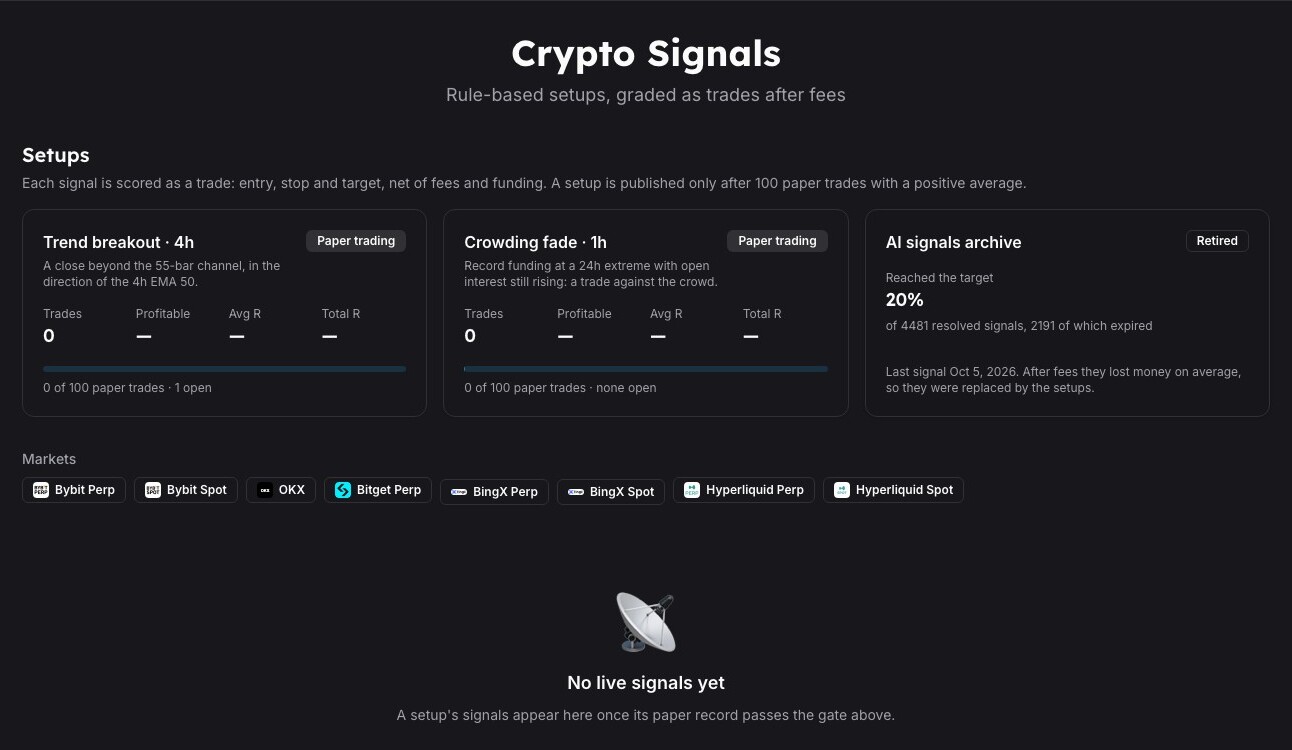
The Signals page tracks rule-based trade setups. Every signal is a complete trade — entry, stop, target and a time limit — and every one is scored as if it had been taken, after fees and funding. Losses and expired signals count too. A setup's signals are shown only after its paper record passes the publication gate. No account needed.
How it works
- Just after each hour closes, Tradiflux checks 15 liquid Bybit USDT perpetuals: BTC, ETH, SOL, XRP, DOGE, BNB, ADA, LINK, AVAX, SUI, 1000PEPE, WIF, ENA, LTC and HYPE.
- When a setup's rule fires on a closed candle, a signal is recorded with its side, stop, target and expiry. There is at most one open signal per coin and setup, and never a long and a short on the same coin at once.
- The signal is graded as a trade on the following candles until it hits the stop, the target or the time limit.
The rules are fixed formulas on price, funding and open interest. No AI is involved.
The setups
| Setup | When it fires | Stop | Target | Time limit |
|---|---|---|---|---|
| Trend breakout · 4h | A 4h close beyond the 55-bar channel, in the direction of the 4h EMA 50 | 2 ATR | 6 ATR | 7 days |
| Crowding fade · 1h | Funding among the most extreme 1% of the last 90 days, the price at its 24h high (or low) and open interest still rising: a trade against the crowd | Beyond the 24h extreme + 1 ATR | 3 ATR | 24 hours |
ATR is the 14-bar average true range on the setup's timeframe. Targets, and the trend breakout stop, are measured from the signal candle's close.
How a signal is graded
- Entry — the open of the first candle after the signal.
- Exit — the stop or the target, whichever is hit first; they never move. A candle that touches both counts as a loss. A stop jumped by a gap fills at the candle's open.
- Time limit — if neither is hit, the trade closes at the close of the last candle before expiry.
- Costs — taker fees on entry and exit, plus funding over the life of the trade (longs pay positive funding, shorts receive it).
- Void — if the entry price is already beyond the stop or the target, there is no trade and it is not counted.
- R — the result in units of the risk to the stop, after costs. +1 R means the trade made as much as the stop would have lost.
Scorecards
At the top of the page each setup has a card:
- the name, the rule, and a status badge — Paper trading or Published;
- Trades — closed trades;
- Profitable — share of trades with a positive result after costs;
- Avg R and Total R;
- a line of cumulative R over the latest trades;
- for a setup still on paper, a progress bar: "n of 100 paper trades · k open".
The publication gate
A new setup trades on paper first: its signals are recorded and graded but not shown. It is published only when both are true:
- its rule showed a positive result after costs in a 12-month backtest;
- at least 100 of its paper trades have closed with a positive average result after costs.
The record belongs to the current version of a setup's rule. Paper trades from before publication stay in it.
Once a setup is published, its signals appear on the page below the scorecards, and new ones arrive in real time. They also show in the side panel of the Explore chart. Until then the list is empty and the Explore panel links to the record.
AI signals archive
Tradiflux used to publish signals written by an AI model. They are retired. The AI signals archive card, marked Retired, keeps their record:
- Reached the target — the share of resolved signals that reached their target; expired signals count as not reached;
- the date of the last signal.
After fees they lost money on average, so they were replaced by the setups.
Signal pages
Every published signal has its own page, including the old AI signals, so earlier links still work. It opens the Explore chart of that coin with the signal's details beside it: exchange, status, timeframe, and the price and time when it was detected. Back to Signals returns to the list.
An open signal also has Ask the AI assistant:
- Click it. The app opens with the AI assistant and the question already asked (guests sign in first).
- The assistant reads the signal and its setup's record, checks the current price, and explains the setup plainly — few closed trades or a negative average R is weak evidence.
- If the trade still makes sense, it proposes a smart order with the signal's stop and its target as the take-profit, risking 1% unless you say otherwise. If the signal has closed, expired or the price has run too far from the entry, it says so instead.
The assistant needs the Basic plan.
Markets
The Markets row on the page links to the free Explore charts of each exchange.
Explore charts
Free TradingView Advanced Charts for Bybit, OKX, Bitget, BingX and Hyperliquid markets — multi-chart layouts, order book, a 30-day grid bot replay and a one-click handoff to the terminal. No sign-up needed.
Bots overview
Grid, DCA bot and recurring buy — which one to pick, how to create one, and how to stop, archive and delete bots on the Bots page.